

The funny thing about writing Part 2 of my’ Motivation and Perseverance with Mental Illness’ blog is that I currently have none. I suppose I have some of the perseverance part actually, because I’m starting this blog no matter what. Motivation though? Ha.
The reason I’ve decided to write, aside from appreciating the irony, is because I don’t enjoy being hypocritical. One of my main ideas for ‘Maintaining Motivation and Perseverance’ is to persevere whether or not motivation is present. Hence the reason I’m here, testing my theory.
No Motivation? No Problem!
That title is a joke. A lack of motivation isn’t just a problem; it sucks! It can be sad, lonely and discouraging. It can make efforts appear futile and exhausting – but we can’t leave it at that! If people only did things when they were motivated, we would have MUCH longer weekends.
Sidebar: I’m starting to think that motivation comes in different flavours.
- Angry motivation: Full-speed ahead, it’s retribution time!
- Spite motivation: I don’t feel like it but you’ve pissed me off and I’ll prove you wrong – if it’s the last thing I do.
- Guilt motivation: I still don’t feel like it but now I feel bad as a person, and have no choice but to redeem myself.
- Passionate/Purposeful motivation: This feels right to me, I’ll stop at nothing!
- Motivation by Proxy: I’m surrounded by productive people who are making it happen. Better join in before I look like a slacker.
- Motivation ‘a la fear’: I’m up an infamous creek without a paddle and is it just me, or is that a f*cking waterfall?
Note: I’d like to mention that ‘forcing’ myself to write has improved my mood a bit. Creativity helps me with motivation.
Lesson 1: Don’t Wait for Motivation
Motivation is like your co-worker who’s always late or that friend who bails on plans. (Uh oh. I might be that friend.) Kidding aside, motivation can be varying degrees of fickle, depending on your brain. I think part of the solution is effectively using motivation when it’s present, but more importantly, learning how to become comfortable working when it isn’t.
When I lack motivation, I try to remind myself of this:
- Motivation fluctuates and no one is constantly ramped up by it.
- Motivation makes effort easier, but a lack of motivation doesn’t make effort (or success) an impossibility.
- Motivation can be found mid-process. It can also come and go within the same project, task, etc.
- Maybe perseverance has more to do with how we function without motivation, and that’s why it’s the part that gets us through.
Lesson 2: Know What Kills Motivation
1. Unrealistic goals and expectations:
One of my favourite quotes used to be “Shoot for the Moon. Even you miss, you’ll land among the stars” (Norman Vincent Peale). I still appreciate the sentiment, but it’s gotten me into hot water. When we aim too high – unrealistically high – we set ourselves up for disappointment. Here’s an example to bring the point home:
You sign up for a marathon despite knowing that you have no experience or practice with running long distances. You drop out on the day of the race, unable to reach the finish line. Then you feel awful and start wondering why you bother to try things at all. The key question however, is this: Given the lack of preparation, is the result that surprising?
The other question you might be wondering is how to recognize unrealistic goals when they pop into our head. That’s a great question because if we have a habit of setting unrealistic goals and expectations for ourselves, it can be difficult to catch ourselves in the act.
To help with this, I created a few questions to ask myself. Maybe they can help you as well, and I’d love to know if you think of others. I’ve been working on a question/answer flow chart that I’m hoping to post soon but here’s an idea of it:
- Is this goal a priority? If so, read on. If not, maybe start by making a list in order of priority.
- Is the goal within my range of knowledge and/or skills? If yes, move along. If not, am I willing to learn what’s required for the goal? (And do I have the time for that?) If yes, move ahead. If not, consider a different objective.
- How ‘perfect’ does this have to be in order for success? Does it require my 150% effort? If not, continue. If so, am I prepared to give that level of time and energy? If yes, continue. If not, determine how important it is for that goal to be achieved right now. If it can be done later, consider waiting for a better time. If the task/objective/etc. must be accomplished now, try to work out a way to get it done with as little stress as possible. (Designated work intervals with breaks, dividing bigger things into smaller steps, etc.)
- How many other open goals/tasks do I have right now? Can I add this to the mix without overstretching myself?
2. Comparisons:
I’ve written about this before and that’s because comparisons can really bring us down if used incorrectly.
If COMPARISON had a warning label, it might read like this:
Warning: Common side-effects may include lowered self-worth, obliterated motivation and crushed dreams.
Call your doctor if you are experiencing depression, heightened anxiety or suicidal thoughts.
It’s hard to stay motivated if you compare your life and accomplishments to those around you. (Or to strangers on social media whose lives are so perfect. Spoiler alert: Their lives aren’t perfect!)
3. Negative Self-Talk:
The way we think and talk about ourselves has a large impact on motivation and perseverance. It’s only natural to become discouraged if we beat ourselves up for every mistake or mishap, but it isn’t constructive. Our inner monologue can’t be that math teacher in High School who made us feel stupid and hate math for the rest of our lives. I’ve heard it said many times now that we spend way too much time with ourselves to let a deprecating voice live there rent-free. It’s important to catch ourselves making mistakes and learn for the future, but not to the point where we destroy our own confidence.
4. Impatience and Instant Gratification:
Another example of how we sabotage our own success is by expecting perfection and/or immediate results. Most goals that are worth attaining aren’t accomplished overnight. Losing motivation when something takes longer than we want it to can really put a dent in our perseverance. I can really relate to this one because I’m impatient and have the unrealistic expectation that if I work well and hard enough, results should appear quickly. The truth is that in many cases, only sustained effort over time will net real change or success. Understanding and accepting that patience is necessary can go a long way.
Lesson 3: Use The Motivation Cycle Wisely
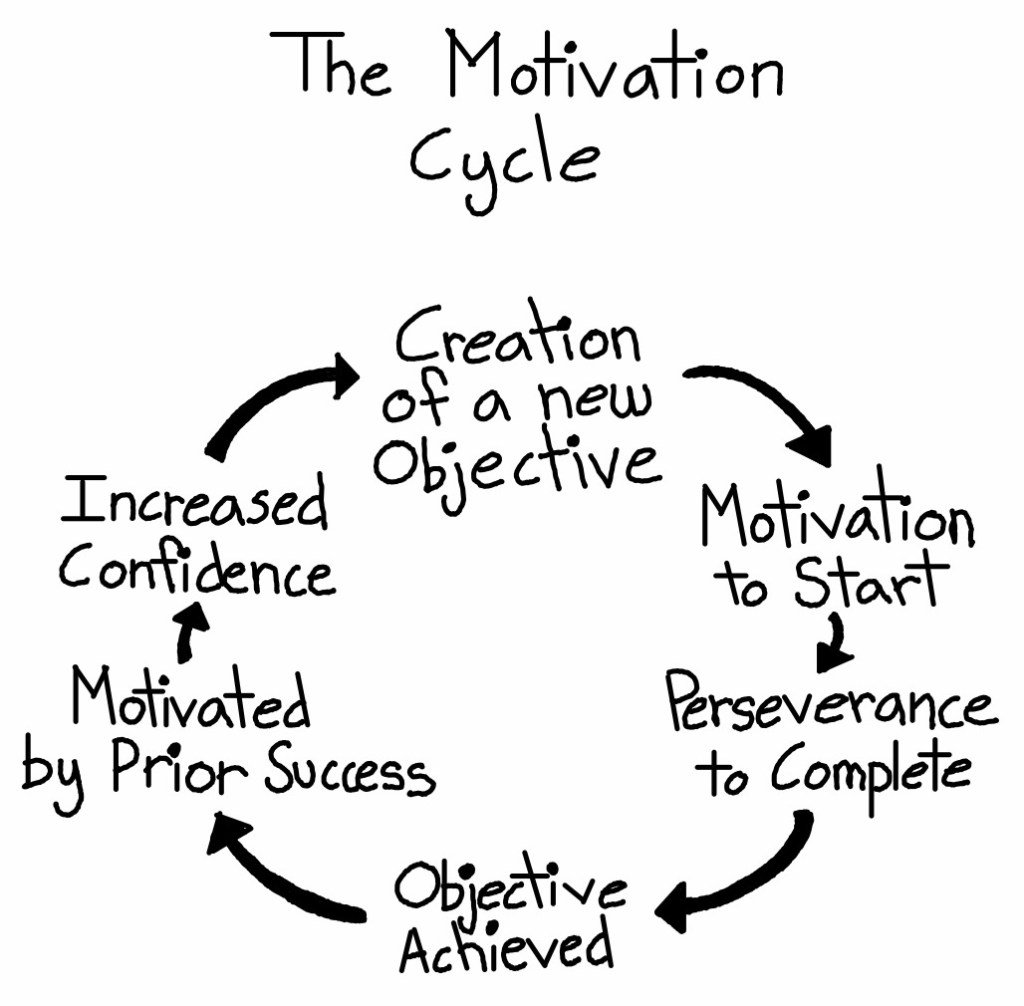
I like the idea of a motivation cycle because I find it to be pretty accurate, at least in my case. Please let me know if you agree.
The theory is that we start by creating a goal, and that goal requires motivation to start.
When motivation runs low – or leaves you high and dry – that’s where perseverance has to kick in and carry things through to the finish line. Objective achieved!
Now that we’re motivated by a recent success our confidence has probably improved. We think of other tasks or goals with a more positive outlook which improves our start-up motivation.
What’s Happening Here?
The more cycles we follow through with, the more motivation and confidence is carried forwards. This makes it smoother and easier to roll with our emotions and, over time, increase the complexity of our goals.
If however the cycle is interrupted, the opposite tends to happen. We can lose faith in ourselves and become less motivated to restart the process. We end up out of the cycle entirely or stuck on step 1, having goals in mind but no inertia to get started, much less keep going.
What to Do When the Cycle is Broken
I’ve broken the motivation cycle so many times that I should qualify as an expert. Even so, knowing what’s happening – and even knowing what to do about it – isn’t always enough. I might have a trick up my sleeve, but let’s just say that I’m not the best magician. Here goes:
My best advice if your motivation cycle is broken is to jump back into it without thinking too much. That’s right! Stop overthinking, and don’t overthink the not overthinking. (I’m reminding myself…) Pick the smallest and easiest goal you can think of that still matters to you, and throw yourself into completing that objective. Motivation or none, do it anyway. Persevere until you’re done and then remind yourself that you’re capable.
Now this is super important – jump into another task right away. Make sure it’s an easy one, but keep yourself in motion. Gradually work your way back up to what you want your productivity and success to look like. It takes time and falling off the cycle many times, but I find it’s best to ride the natural rythme of motivation-completion-satisfaction inertia.
Summary
In this post we’ve talked about different flavours of motivation, learning how to work without it, avoiding unrealistic goals and expectations, reducing comparisons, letting go of negative self talk, and coming to terms with patience.
We also talked about the motivation cycle and “building a platform of little wins” to build up our confidence, get the motivation cycle out of neutral and back into gear. After that, we can slowly up the difficulty of our goals, keeping them realistic in relation to how we feel.
These tips won’t change everything but hopefully you found this interesting and/or helpful.
This blog wasn’t even very long but there’s so much going on right now that it was difficult to work on it. I hope you enjoyed the read and I hope to be back sooner…
Take care everyone!

 I Will Not BE My Mental Illness